KXD Steel Technical & Project Team | Steel Structure Engineering Group | Published September 3, 2026
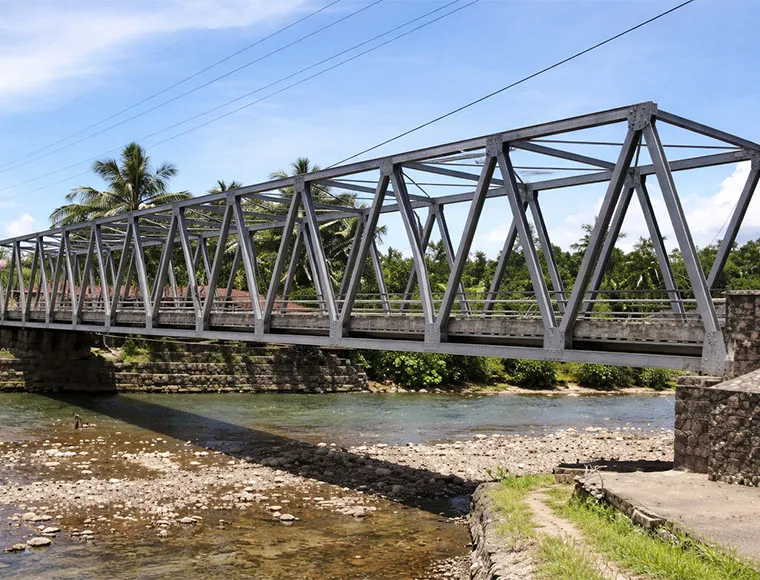
A prefabricated steel truss pedestrian bridge is a factory-built, bolt-up structure sized per crossing rather than sold off a fixed dimension chart. Deck width, span and shipping-segment length are engineered per project; what’s standardized across orders is the structural approach, minimum order size and certification.
Why There’s No Universal Spec Sheet for This Product
Municipal project documents and academic deck-material papers each publish numbers for one specific bridge — a named footbridge with its own span, its own deck width, its own shipping plan. None of them consolidate those figures into a selection table a buyer can use before a project is scoped, and neither does a single supplier’s spec sheet, because pedestrian truss bridges aren’t manufactured to a catalog dimension the way a standard I-beam is. Span, width and load rating get engineered against the specific crossing, foundation conditions and code jurisdiction.
That’s a different situation from KXD’s building products, where the company publishes a fixed span range (up to 100 m) for standard steel structure buildings. For the Prefabricated Steel Bridge / Modular Steel Bridge line (model KXDF-01), the published product information covers structural configuration and order parameters rather than a numeric span table — a distinction worth stating plainly rather than blurring the two product lines together.

What’s Actually Published for This Product
| Parameter |
Published Detail |
| Structural configurations offered |
Steel truss, plate girder, welded box girder |
| Construction method |
Modular / prefabricated, bolt-up field assembly |
| Applications |
Highway, railway, pedestrian, industrial, mining, temporary access, urban overpass |
| Minimum order quantity |
600 m² |
| Monthly supply capacity (product line) |
8,000 tons |
| Certification listed on product page |
ISO |
| Price range |
USD 40–100/m², depending on specification |
| Specific clear-span figures |
Not published — engineered per project |
| Deck width standards |
Not published — engineered per project |
| Shipping-segment length limits |
Not published — depends on route and transport method |
Three rows in that table say “not published” rather than a number, and that’s intentional. Filling them with plausible-sounding figures would misrepresent what KXD has actually disclosed for this specific product line, even though such figures exist informally for buildings and get requested for bridges during quoting.
How Truss Configuration Affects Span Decisions
Even without a fixed span table, the structural logic that governs pedestrian truss bridges is consistent across the industry and worth laying out:
- Triangulated members carry load more efficiently than a solid web at longer spans, which is why truss configuration is typically the default once a footbridge needs to clear a road, rail line or waterway rather than a short gap.
- Deck width is driven by expected pedestrian and cyclist volume, not by the truss span itself — a wide multi-use path crossing needs more deck width than a narrow single-file footbridge regardless of how far it spans.
- Shipping-segment length is set by route restrictions, not by an ideal fabrication size. A truss bridge that could ship as two long modules may need to be broken into three or four shorter segments if the delivery route has tight turns, low bridges or weight-restricted roads.
- Foundation and abutment design changes with span and site soil conditions, which is one reason a fixed span-to-price chart doesn’t hold up project to project.
This is also where the most common misreading happens: treating “prefabricated” as a synonym for “standardized dimensions.” Prefabrication describes how the bridge is built (shop-fabricated, shipped as modules, bolted on site) — not that every order shares a catalog span or width.
Applications Where This Configuration Gets Specified
Pedestrian crossings over roads or rail — the primary use case for truss configuration in footbridge projects, chosen for span efficiency over a plate girder.
- Multi-use paths (pedestrian plus cyclist) — deck width becomes the deciding parameter more than span.
- Temporary or relocatable pedestrian access — bolt-up assembly means the structure can be dismantled and moved if the crossing is short-term.
- Combined vehicle/pedestrian urban overpasses — sometimes paired with box girder sections where torsional loading from mixed traffic is a factor.
FAQ
Q: What span can a prefabricated steel truss pedestrian bridge cover?
A: KXD doesn’t publish a fixed span table for this product; span is engineered per crossing based on site conditions and load requirements, and gets confirmed during the quoting process.
Q: What’s the minimum order size?
A: 600 m², the same MOQ published across KXD’s bridge product line.
Q: Does a longer span cost proportionally more per square meter?
A: Pricing sits in the USD 40–100/m² range depending on specification, but span alone isn’t the only driver — deck width, load class and site/foundation conditions all factor into where a project lands in that range.
Q: Can the bridge be shipped in one piece?
A: Not usually. Modular sections are sized to route restrictions (turns, clearance, weight limits) as much as to fabrication convenience, so segment count typically depends on the delivery route, not a fixed shipping standard.
Buyers comparing pedestrian truss bridge options should treat published span and width figures from other projects as reference points, not as a menu — the numbers that matter are the ones that come back from an actual site and load review.



 September 03, 2026