A steel bridge design example lines up a structural configuration, truss, plate girder or welded box girder, against project constraints such as span, erection method and site access, before detailed calculation begins. This comparison reflects KXD Steel’s currently published prefabricated bridge specifications, current as of September 2026.
What “Design Example” Means Before the Calculation Starts
A design example, in the bridge context, is not a stamped set of calculations. It is the earlier decision: which structural family carries the load, how the deck ties into that family, and how the finished structure breaks into shippable modules. Get that sequence wrong and the calculation stage inherits the mistake.
KXD’s Prefabricated Steel Bridge / Modular Steel Bridge line (model KXDF-01) is built around three structural families: steel truss bridges, plate girder bridges and welded box girder bridges, each assembled from prefabricated modules rather than built up entirely on site.
A Common Misread: Treating the Example as the Final Design
Project owners sometimes read a comparison like this one as a stand-in for structural sign-off. It isn’t. Span capacity, deck width and connection detailing still have to be verified against the actual site, code jurisdiction and loading case before fabrication drawings are issued. KXD has not published a per-type span table for this line, so attaching a specific span figure to one configuration in this article would be invented rather than sourced. That number is left out for that reason, not because it doesn’t matter.
Why the Structural Type Decision Comes First
Search results for this topic lean toward code-specific academic and DOT material, the kind of resource an engineer checking a fatigue detail needs, not a project owner comparing three bridge types before a supplier call. That gap is why this article stays at the configuration level: what changes about fabrication, connection and delivery when a project moves from a truss deck to a box girder, rather than how to run a load combination.
Each family carries load differently, and that difference drives what happens in the shop and on site:
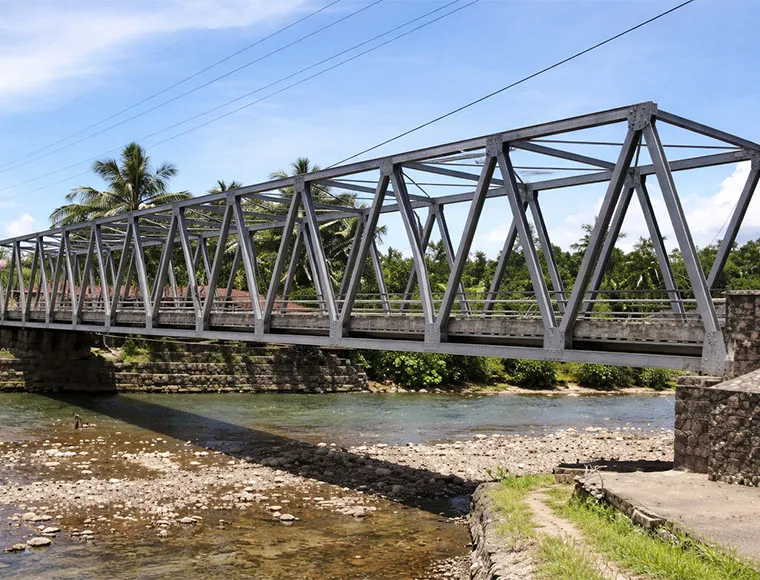
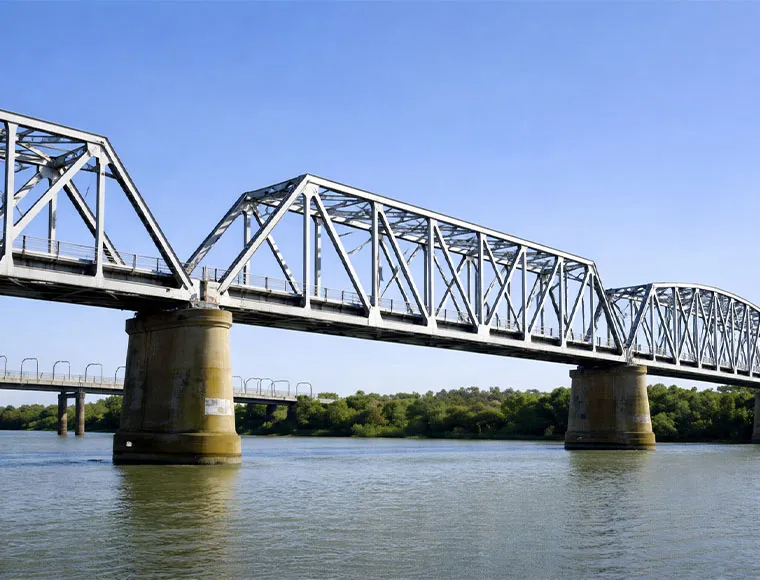
- Steel truss bridge. An open web of triangulated members carries load mainly through axial tension and compression in the chords and diagonals rather than bending in a solid web. For a given steel weight, a truss can usually reach a longer clear span, but the geometry means more discrete shop-fabricated joints to erect in the field.
- Plate girder bridge. A solid web plate with top and bottom flanges carries load mainly through bending. Fewer discrete parts generally means a faster erection sequence for moderate spans, at the cost of a heavier section than an equivalent truss covering the same distance.
- Welded box girder bridge. A closed, typically rectangular or trapezoidal cross-section formed from welded plates. The closed section resists torsion well, which is why it tends to come up for curved alignments or crossings carrying an off-center traffic load. Welded construction, rather than bolted, is the connection method KXD’s own product naming confirms for this configuration.
Three Structural Configurations Side by Side
| Configuration |
Primary Load Path |
Field Connection |
Where It Tends to Fit |
What Still Needs Project Confirmation |
| Steel truss bridge |
Axial forces through triangulated chords and diagonals |
Bolted field splices at panel points (general industry practice) |
Longer clear spans for a given steel weight |
Exact span range and panel spacing for the KXDF-01 line |
| Plate girder bridge |
Bending through a solid web plate with top and bottom flanges |
Bolted or welded flange splices (general industry practice) |
Moderate spans with a simpler erection sequence |
Deck width and girder spacing specific to this line |
| Welded box girder bridge |
Torsion resistance through a closed welded cross-section |
Full-penetration welded seams (confirmed by KXD’s product naming) |
Curved alignments and eccentric or off-center loading |
Wall thickness and stiffener spacing for this line |
KXD’s product naming confirms welded construction for the box girder configuration specifically. The field-connection practice listed for the truss and plate girder configurations reflects common bridge-engineering practice, not a KXD-published spec, and should be confirmed against project-specific drawings rather than assumed from this table.
KXDF-01: What Ships Across All Three Configurations
Regardless of which structural family a project selects, KXD documents the following for the Prefabricated Steel Bridge / Modular Steel Bridge (KXDF-01) line:
- Applications: highway, railway, pedestrian, industrial, mining, temporary access and urban overpass projects
- Minimum order quantity: 600 m²
- Published supply capacity: 8,000 tons/month, a catalog-level figure covering KXD’s steel structure building, bridge and poultry house lines together, not a bridge-only number
- Certification listed on the product page: ISO
- Price range: USD 40 to 100 per square meter, depending on specification
FAQ
Does the span range differ between the truss, plate girder and box girder options?
In general bridge engineering, yes, different structural families typically span different distances for the same steel weight. KXD’s published materials don’t break out span ranges by configuration for the KXDF-01 line, so confirm this with a project-specific engineering request rather than assuming a figure from general references.
Is one of the three configurations more affordable than the others?
KXD publishes one price range, USD 40 to 100 per square meter, for the Prefabricated Steel Bridge line rather than separate ranges per configuration. The final number depends on specification, so an early quote request is the reliable way to compare cost across configurations.
Which configuration suits a curved or eccentrically loaded crossing?
A closed cross-section, the box girder’s defining feature, resists torsion more effectively than an open truss or a single plate girder web, which is why closed sections are the common choice for curved alignments in general bridge engineering. Confirm this against the actual alignment and loading with KXD’s engineering team before committing to it.
What does “modular” mean for delivery timelines?
It means the bridge ships as prefabricated sections rather than requiring full on-site fabrication. KXD hasn’t published a standard lead time for the bridge line in current materials, so timeline needs to be requested per project.
The open question for any of these three configurations is the same one: how span, deck width and connection detailing interact with the actual crossing, not just the general mechanics described here. That gets answered once KXD’s engineering team has the site geometry in hand, not before.


 September 20, 2026