KXD Steel Technical & Project Team | Steel Structure Engineering Group | Published September 7, 2026
Steel bridge construction runs through four linked phases: shop fabrication, trial assembly, transport segmentation and on-site bolt-up erection. Most of the schedule risk sits in the phases before delivery — road or lane closure time is driven almost entirely by how well those earlier stages were sequenced, not by the erection itself.

Phase 1: Shop Fabrication
- Cut and prepare steel members to the structural design — truss chords, plate girder webs and flanges, or box girder plates, depending on which configuration the project specifies.
- Weld primary connections in a controlled shop environment, where tolerances can be measured and corrected before a part ever leaves the factory. This is the stage where a dimensional error is cheapest to catch.
- Drill and match bolt holes for the field connections that will be made on site later. Hole alignment gets verified against the connecting member here, not assumed from drawings alone.
- Apply corrosion protection — paint system or hot-dip galvanizing, chosen based on site exposure conditions — before the component ships.
Completion check: every fabricated section should be dimensionally inspected and documented against the shop drawing before moving to trial assembly. Skipping this check is the single most common cause of on-site fit-up delays later.
Phase 2: Trial Assembly
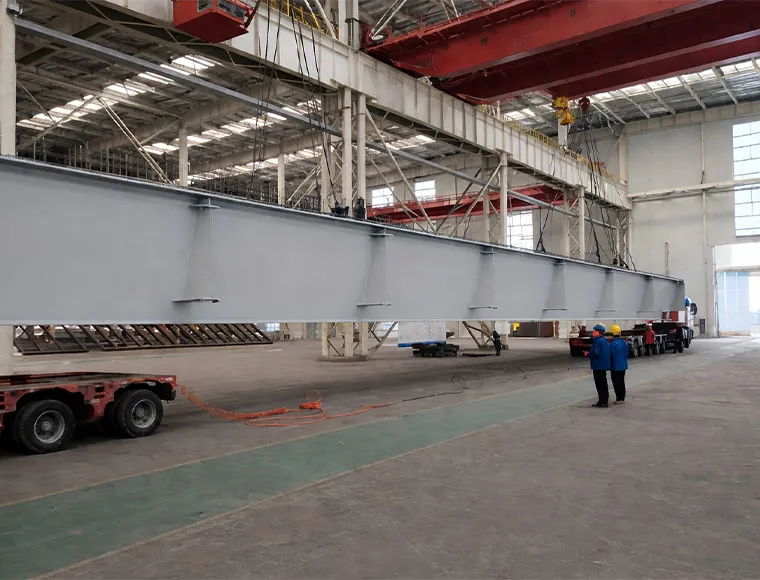
- Assemble major sections in the shop or a staging yard before shipping, checking that bolt holes line up and connections fit without forcing.
- Mark and number every match-fit component so the same orientation and sequence get reproduced exactly on site — a step that’s easy to treat as bureaucratic paperwork and expensive to skip when it is.
Trial assembly is the phase competitors’ specification-audience documents tend to treat as a footnote, even though it’s what prevents a crew from discovering a misalignment for the first time on a closed road. Buyers evaluating a fabricator should ask specifically whether trial assembly is included, not assume it is.
Phase 3: Transport Segmentation
- Segment the structure into shippable modules sized against route restrictions — turning radius, bridge clearance, road weight limits — not against an ideal fabrication size. A structure that would ship in two pieces on an unrestricted route may need three or four segments if delivery has to pass through a constrained corridor.
- Sequence delivery to match the erection order, so modules arrive in the sequence they’ll be lifted, rather than in the order that was most convenient to load.
Phase 4: On-Site Bolt-Up Erection
Prepare foundations and abutments in parallel with fabrication, so the site is ready the moment modules arrive — this parallel scheduling is what actually compresses total project time, more than any speed gained during erection itself.
- Set and align the first module against the completed foundation, checking level and alignment before the second module connects to it. Every subsequent connection compounds any error introduced here.
- Bolt subsequent modules in the pre-planned sequence, following the match-marks established during trial assembly rather than re-deriving fit-up in the field.
- Torque and inspect every bolted connection against the specified torque values, documenting each connection rather than spot-checking a sample.
- Complete final inspection and load verification before the crossing reopens to traffic.
Completion check: a bolt-up erection that followed steps 5–8 correctly should require no field welding and minimal on-site cutting — if either becomes necessary, it usually traces back to a trial-assembly or transport-segmentation step that was skipped or rushed.
Completion check: a bolt-up erection that followed steps 5–8 correctly should require no field welding and minimal on-site cutting — if either becomes necessary, it usually traces back to a trial-assembly or transport-segmentation step that was skipped or rushed.
What Actually Determines Road-Closure Length
The common misconception in construction-schedule planning is assuming erection time scales directly with bridge size. In practice, erection duration is driven more by how many bolted connections have to be made and how well those connections were pre-matched in trial assembly than by overall span or tonnage. A larger bridge that went through thorough trial assembly can erect faster than a smaller one where match-marking was skipped and crews are fitting connections for the first time on site.
Product Parameters for This Build Sequence
This sequence applies to KXD’s Prefabricated Steel Bridge / Modular Steel Bridge line (model KXDF-01):
- Structural configurations: steel truss, plate girder, welded box girder
- Construction method: modular/prefabricated, bolt-up field assembly
- Applications: highway, railway, pedestrian, industrial, mining, temporary access, urban overpass
- Minimum order quantity: 600 m²
- Published monthly supply capacity for this product line: 8,000 tons
- Certification listed on the product page: ISO
- Price range: USD 40–100/m², depending on specification
FAQ
Q: How long does bolt-up erection typically take compared to field-welded construction?
A: KXD doesn’t publish a fixed erection-time figure, since it depends on span, module count and site access — but bolt-up assembly removes weather-dependent field welding from the critical path, which is the main reason it’s generally faster than welded alternatives for comparable projects.
Q: Is trial assembly always necessary?
A: For bolt-up modular bridges, skipping trial assembly shifts the risk of a fit-up mismatch to the job site, where it’s far more expensive to correct — trial assembly is the step that catches that error while it’s still cheap to fix.
Q: What decides how many segments a bridge ships in?
A: Route restrictions — turning radius, overhead clearance and road weight limits along the delivery path — rather than an ideal fabrication size.
Q: Can foundation work start before fabrication is finished?
A: Yes, and doing so in parallel is one of the most effective ways to shorten total project time, since it means the site is ready when modules arrive rather than becoming the next bottleneck.
Buyers scoping a project should ask a fabricator directly whether trial assembly and match-marking are included in the quoted process — the answer says more about expected site duration than the published span or price range does.



 September 04, 2026