KXD Steel Technical & Project Team | Engineering & Project Delivery, Qingdao KXD Steel Structure Co., Ltd. | Published: August 17, 2026
A custom steel structure building from a Chinese exporter runs USD 40–100/m² for the structural package. Where a project lands inside that band depends on span, eave height, cladding type and crane loading. This article maps each of those variables to the part of the range it pushes toward.
Pricing below reflects KXD’s published product-page ranges as of August 2026. Steel is a traded commodity, so re-confirm any figure older than one quarter before using it in a budget.
What USD 40–100/m² Actually Covers
The published range applies to the fabricated steel package: main frame, secondary members, connection materials, surface treatment and the enclosure system quoted with it. It is a supply figure, not a delivered-and-erected figure.
Four cost categories sit outside it and routinely surprise first-time importers:
- Ocean freight and inland haulage to site
- Import duty, VAT and customs clearance in the destination country
- Concrete foundation work, which is priced locally and can equal a meaningful share of the steel package on soft ground
- Site erection labour and crane hire, though engineering supervision and drawings are supplied
For a mid-spec 3,000 m² workshop, the structural package might sit around USD 60/m². The landed, erected number in the destination market will be higher, and how much higher is a function of the port, the tariff line and local labour rates rather than anything the fabricator controls.
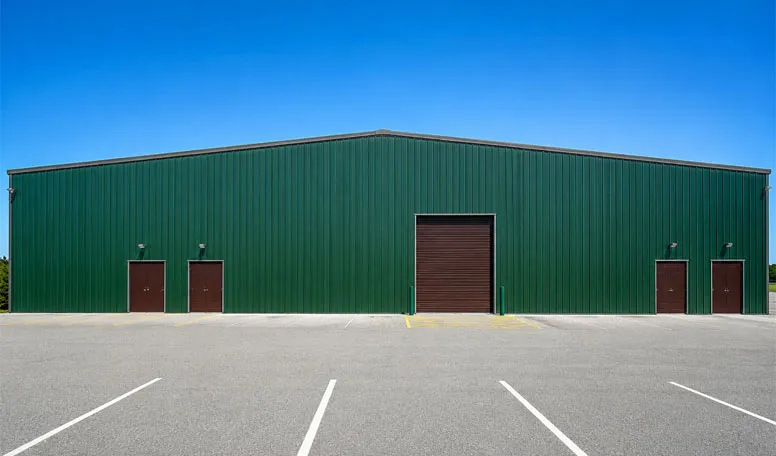
Spec-to-Price Table: Which Variables Move the Number
One published range covers a wide configuration space. The table below is a directional mapping — it shows which specification choices sit toward each end of USD 40–100/m², not itemised line-item prices, because a per-variable price split is not something KXD publishes.
| Specification variable |
Sits near USD 40/m² |
Sits near USD 100/m² |
| Clear span |
15–24 m, single span |
60–100 m, single span |
| Eave height |
6–8 m |
20–30 m |
| Roof and wall system |
Single-skin sheet, 0.4–0.5 mm |
100–150 mm rock wool or PU sandwich panel |
| Overhead crane |
None |
Crane beams and rails sized for heavy duty |
| Wind design |
Standard regional loading |
Customised toward the 160 km/h ceiling |
| Surface treatment |
Painted system |
Hot-dip galvanized components |
| Order size |
Well above the 600 m² MOQ |
At or near MOQ, short run |
| Steel grade |
Q235B throughout |
Q355B in heavily loaded members |
Two readings of this table matter more than the rest. First, span is the dominant driver, because doubling clear span increases member depth and weight faster than it increases floor area. Second, insulation choice can move the enclosure cost more than the frame itself on a low-height building, which is why two quotes for the “same” 3,000 m² shed can differ by 40% without either being wrong.
Inside the Custom Steel Structure Building Spec Sheet
The pricing above attaches to a defined product envelope. KXD’s Custom Steel Structure Building is published with these parameters:
| Parameter |
Published value |
| Main frame |
Q235B / Q355B welded H-section |
| Clear span |
Up to 100 m single-span |
| Building height |
3–30 m |
| Roof slope |
1:10–1:5 |
| Wind resistance |
Up to 160 km/h, customizable |
| Cladding options |
Single-skin steel, EPS, PU, rock wool, glass wool |
| Design lifespan |
50+ years |
| MOQ |
600 m² |
| Supply capacity |
8,000 tons/month |
| Quality framework |
CE (EN 1090), ISO 9001, ISO 14001, ISO 45001; WPQR on request |
The MOQ line deserves attention at quotation stage. At 600 m², a 20 m × 30 m building is the practical floor. Buyers wanting a 200 m² structure are looking at a different product category, and pushing a sub-MOQ enquiry through a full custom workflow usually returns a per-square-metre figure well above the published band.
Why $/sq ft Kit Pricing Misleads Export Buyers
Search for this topic in English and most of the front page returns US domestic kit pricing quoted in dollars per square foot, typically with a spread of two or three times and no explanation of what sits inside it.
That number is not portable. It bundles a domestic delivery radius, US-code engineering, local steel procurement and a distribution margin into a single figure. Compared with US-market kit distribution offers generally, an export FOB quote is a narrower, more literal package: steel, fabrication, coating, packing to port.
|
US retail kit pricing model |
Export FOB structural package |
| Quoted unit |
USD per sq ft |
USD per m² |
| Typical inclusion |
Frame, sometimes basic sheeting, domestic delivery |
Frame, secondary members, coating, enclosure as specified, packing |
| Engineering basis |
Stamped to one national code |
Designed to GB / ASTM / AISI / JIS / BS as the destination requires |
| Freight |
Inside the price |
Buyer’s scope from port onward |
| Duty and clearance |
Not applicable |
Buyer’s scope |
| Foundations |
Excluded |
Excluded |
| Minimum order |
Often none |
600 m² |
The common mistake is converting a $/sq ft kit figure to $/m² and treating it as comparable to an FOB quote. The two describe different scopes, and the conversion produces a number that is arithmetically correct and commercially meaningless.
Building a Comparable Estimate in Five Steps
- Fix the building envelope first. Write down clear span, length, eave height, bay spacing and roof slope. Without these, any quote you receive is a guess dressed as a price.
- State the governing code and site loads. Wind speed, snow load and seismic category for the actual site. A building designed to a 160 km/h wind ceiling costs differently from one designed to a standard regional value.
- Specify the enclosure separately from the frame. Ask for the frame tonnage and the enclosure area to be priced as separate lines. This single request makes two competing quotes comparable.
- Declare crane requirements up front. Capacity, span, hook height and duty class. Retrofitting crane support into a frame already fabricated is the most expensive change order in this product category.
- Convert FOB to landed cost before comparing. Add freight, duty, insurance, unloading, foundation and erection using local quotes, then compare the totals rather than the factory prices.
An edge case worth flagging: buildings on soft or reclaimed ground. The steel package price barely moves, but foundation scope can shift the project total substantially. Buyers who compare fabricators on steel price alone, on a site with poor bearing capacity, are optimising the smaller half of the budget.
Where Steel Costs More Than the Alternatives
Honest cost content has to include the cases where this product loses.
Below roughly 600 m², prefabricated steel loses its economics to local masonry or light-frame construction in most markets, and the MOQ makes the point structurally rather than as a matter of preference. Long, thin buildings under 15 m span rarely justify the import overhead either.
Steel prices move with the commodity market, so a quotation validity window of two to four weeks is normal in this trade. Buyers running a six-month procurement cycle should expect to re-price, and should treat any fabricator offering an indefinite price hold with some suspicion about what has been padded to make that possible.
There is also a coordination cost that does not appear on any invoice. Importing a structural package means managing a foreign engineering team, a freight forwarder, a customs broker and a local erection contractor as separate parties. Firms with in-house project management absorb this comfortably. Firms without it sometimes find that the coordination effort erodes the unit-price advantage that made the import attractive.
Certification and What It Adds to the Line Item
Certification requirements change the quotable price, so they belong in the specification rather than in a later negotiation.
For European destinations, the European Commission states that CE marking on construction products indicates conformity with declared performance assessed under a harmonised European standard or a European Technical Assessment, and Commission material references EN 1090 specifically for structural products. A fabricator without EN 1090 factory production control cannot legally supply CE-marked structural steelwork into that market, whatever the quoted price.
The management-system certificates behave differently. ISO defines ISO 9001 as its quality management system standard, ISO 14001 as its environmental management system standard, and ISO 45001 as its occupational health and safety management system standard. These describe how a supplier runs its processes, not the performance of the delivered steel. They are relevant to supplier due diligence and largely neutral to the per-square-metre figure.
Third-party inspection through SGS, Bureau Veritas or Intertek is available on request for KXD projects. It is a scoped, chargeable service, and it should appear in the enquiry rather than being assumed as included.
FAQ
Q: What is the price per square metre for a steel structure building?
A: USD 40–100/m² is the published range for KXD’s Custom Steel Structure Building, covering the fabricated structural package. Some legacy metal-construction project listings are published at USD 30–80/m², negotiable. The applicable figure depends on span, height, cladding and crane requirements.
Q: Does that price include installation?
A: No. The published range is a supply figure. Engineering drawings and erection support are provided; site labour, crane hire and foundation work are priced locally by the buyer.
Q: What is the minimum order?
A: 600 m² for the Custom Steel Structure Building. Some other products in the range, including PEB and multi-storey steel buildings, are listed at 200 m².
Q: How much does a 1,000 m² steel workshop cost?
A: At the published range, the structural package for 1,000 m² falls between USD 40,000 and USD 100,000. A single-storey 24 m span workshop at 8 m eave height with single-skin cladding and no crane sits near the lower figure; the same footprint with 100 mm rock wool panels and a 10 t crane moves toward the upper one. A firm number requires the span, height and load data.
Q: Why do quotes for the same building size differ so widely?
A: Usually because the frame weight differs. Two fabricators can design the same envelope to different steel tonnages depending on member optimisation and code assumptions. Ask for the frame tonnage alongside the price and the comparison becomes straightforward.
Q: Can the price be held while we arrange financing?
A: A validity window of two to four weeks is standard, reflecting steel market movement. Longer holds are negotiable but typically priced in.
Q: What documentation should accompany the quotation?
A: Frame tonnage, steel grade per member group, coating specification with dry film thickness, enclosure specification, the design code applied, and the packing list basis for the FOB figure.
Next: What to Send a Fabricator
If you are moving from research to enquiry, the fastest path to an accurate number is a single-page brief containing: site location and coordinates, building envelope dimensions, crane data if any, the governing design code, and the destination port.
One question this article does not answer, and which matters for anyone building in a market with an active local steel fabrication industry: whether importing a full structural package beats buying local steel and importing only the engineering. That trade-off is market-specific and worth pricing separately before committing to either route.
About the author: The KXD Steel Technical & Project Team works on design, detailing, fabrication and delivery of prefabricated steel structures for industrial, commercial, logistics, agricultural and infrastructure applications, drawing on steel-structure expertise dating to 1997 and project experience across more than 80 countries and regions.



 August 17, 2026