Équipe technique et projets KXD Steel | Groupe d’ingénierie des structures métalliques | Publié le 2 septembre 2026
A pont modulaire en acier est une structure préfabriquée expédiée en sections boulonnées plutôt que coulée ou soudée sur site. La configuration appropriée — treillis, poutre à âme pleine ou poutre-caisson soudée — dépend moins de la portée seule que de la manière dont le franchissement sera chargé, accessible et assemblé.
Trois types de structures, trois fonctions différentes
Tous les ponts en treillis métalliques ne se ressemblent pas une fois passées les photos marketing, et les trois configurations fabriquées par KXD répondent à des problèmes différents.
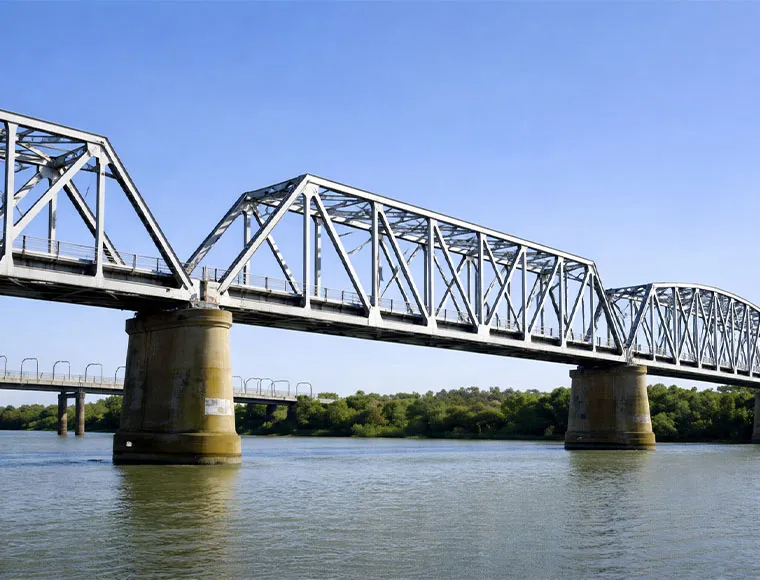
Les ponts à treillis en acier utilisent des éléments triangulés pour reprendre les charges, ce qui réduit le poids d’acier par rapport à la portée. Ils conviennent aux franchissements routiers et ferroviaires lorsqu’un long vide sans appui intermédiaire est inévitable et lorsque la structure en treillis ouvert facilite également les inspections ultérieures.
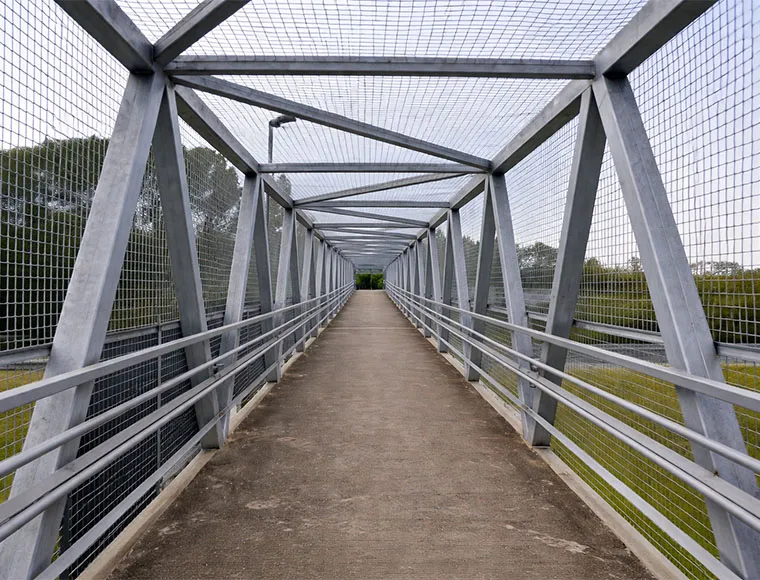
Les ponts à poutres en tôle reposent sur des plaques pleines soudées plutôt que sur un treillis triangulé. Leur fabrication coûte moins cher pour les petites et moyennes portées, et leur intrados plat facilite les travaux lorsque la hauteur libre sous le tablier est limitée, par exemple pour une passerelle piétonne au-dessus d’une route.
Les ponts à poutres-caissons soudées forment une section fermée en caisson résistant à la torsion. Cette rigidité torsionnelle est particulièrement importante lorsque le pont doit supporter des charges inégales ou excentrées, comme sur les voies de transport minier, les passages supérieurs urbains courbes ou les franchissements accueillant à la fois des véhicules et des piétons sur un tablier asymétrique.
Aucune des trois configurations n’est universellement “ meilleure ”. Une poutre en tôle conçue pour une voie de transport minier soumise aux sollicitations latérales de chariots élévateurs se tordra davantage qu’une poutre-caisson ; une poutre-caisson conçue pour une courte passerelle piétonne fait généralement payer une rigidité dont personne n’a besoin.
Domaines d’utilisation de chaque configuration
Les applications publiées par KXD pour cette gamme de produits couvrent les projets d’autoroutes, de chemins de fer, de passerelles piétonnes, de sites industriels, de mines, d’accès temporaires et de franchissements urbains. En pratique, le type de structure est associé au cas d’utilisation comme suit :
1. Franchissements autoroutiers et ferroviaires — configuration en treillis pour de longues portées libres avec une charge centrée et prévisible.
2. Passerelles piétonnes et franchissements urbains légers — poutre à âme pleine, privilégiant un coût de fabrication réduit et une faible hauteur de tablier.
3. Voies de transport minières et industrielles — poutre-caisson, lorsque les sollicitations de torsion dues aux équipements lourds sont courantes plutôt qu’occasionnelles.
4. Ponts d’accès temporaires — treillis ou poutre à âme pleine, choisis principalement en fonction de la rapidité d’assemblage des modules par boulonnage et de leur facilité de déplacement.
Les projets d'accès temporaires méritent une remarque distincte : le facteur déterminant est rarement la capacité portante. Il s'agit plutôt du nombre de connexions boulonnées qu'une équipe doit réaliser avant que le tablier puisse être ouvert à la circulation, ce qui relève davantage de la planification que de l'ingénierie.
Comparaison des types en un coup d'œil
| Facteur |
Pont à treillis |
Pont à poutres en tôle |
Poutre-caisson soudée |
| Usage typique |
Autoroute, chemin de fer, grandes portées |
Piéton, portée courte à moyenne |
Exploitation minière, industrie, chargement courbe/asymétrique |
| Cheminement des charges |
Membrures triangulées |
Âme pleine soudée |
Caisson fermé résistant à la torsion |
| Rigidité torsionnelle |
Modérée |
Inférieur |
La plus élevée |
| Complexité de fabrication |
Plus élevée (davantage de soudures/assemblages) |
Inférieur |
Plus élevée (soudage de sections fermées) |
| Dégagement du tablier |
Plus de hauteur requise |
Sous-face peu profonde |
Modérée |
| Le mieux adapté aux projets temporaires/relocalisables |
Oui |
Oui |
Moins courant |
Comparé aux communiqués de presse des fournisseurs et au jargon des dépôts de brevets qui dominent la plupart des résultats de recherche sur ce sujet, ce tableau vise à répondre à une question plus précise : quelle configuration correspond à une condition de charge et d'accès donnée, et non quelle marque a construit le pont le plus haut l'année dernière.
Construction modulaire : ce que le “ boulonnage ” change réellement sur site
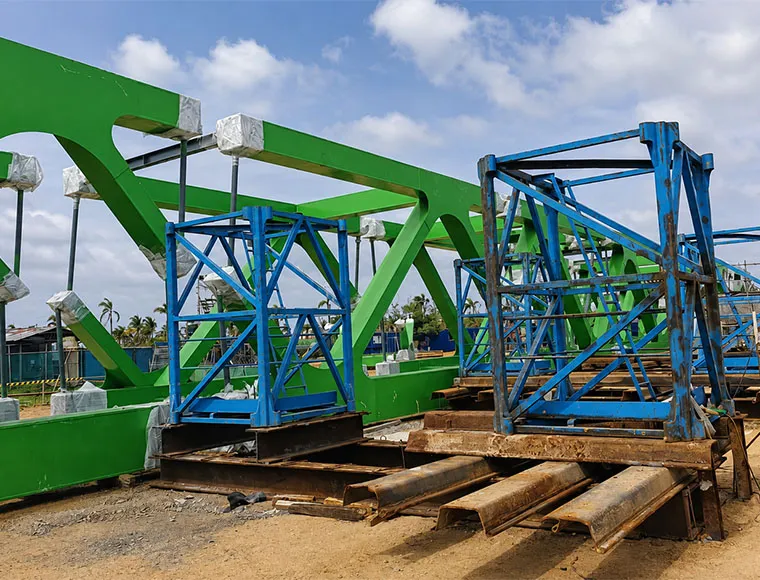
Le paramètre qui affecte le plus un calendrier de construction n'est pas la portée ou la nuance d'acier — c'est de savoir si le pont est soudé sur site ou modulaire boulonné. Le pont en acier préfabriqué de KXD (Pont en acier modulaire, modèle KXDF-01) est fabriqué et pré-assemblé en atelier, puis expédié en sections qui sont boulonnées ensemble sur site.
Cela transfère le travail du chemin critique du chantier vers l'usine :
- Les sections sont découpées, soudées et pré-percées pour s'ajuster en atelier, où les tolérances sont contrôlées et les retouches sont peu coûteuses à détecter.
- Les modules sont expédiés sur site sous forme d'unités discrètes et levables plutôt que sous forme de tôles et de poutres brutes.
- Les équipes boulonnent les connexions en séquence plutôt que de réaliser des soudures sur site, ce qui réduit le nombre d'opérations dépendantes des conditions météorologiques.
- L’inspection porte sur le couple de serrage des boulons et l’alignement, plutôt que sur les contrôles de qualité des soudures, qui nécessitent la présence d’inspecteurs en soudage certifiés sur le chantier.
Le compromis, c’est que les assemblages boulonnés exigent dès le départ des tolérances de fabrication plus serrées : une erreur d’atelier qui pourrait être corrigée rapidement par une soudure sur le chantier devient une pièce expédiée qui ne s’aligne pas. C’est une véritable limite dont il faut tenir compte dans la planification, pas un détail secondaire.
Positionnement de ce produit selon la portée et la taille de la commande
Les paramètres publiés par KXD pour cette gamme sont plus restreints que ceux de ses produits de construction, et il vaut mieux l’énoncer clairement plutôt que de l’enrober d’adjectifs :
- Configurations proposées : treillis en acier, poutre à âme pleine, poutre-caisson soudée — toutes disponibles sous forme modulaire ou préfabriquée.
- Quantité minimale de commande : 600 m².
- Capacité d'approvisionnement publiée pour cette catégorie de produit : 8 000 tonnes/mois.
- Certification indiquée sur la page produit : ISO.
- Fourchette de prix : 40 à 100 USD/m², selon les spécifications.
Deux éléments ne sont pas publiés pour cette ligne spécifique et ne doivent pas être présumés en reprenant des chiffres du catalogue de bâtiments de KXD : une valeur explicite de portée libre et une durée de vie de conception indiquée. Les acheteurs qui comparent ce produit à des structures en acier de qualité bâtiment devraient demander des chiffres de portée et de durée de vie propres au projet plutôt que de supposer que la durée de vie de conception de 50 ans de la ligne bâtiment s'applique également — les charges de pont et les cycles de fatigue relèvent d'une problématique d'ingénierie différente.
Une confusion courante : “ modulaire ” ne signifie pas “ standardisé pour tous ”
L’erreur la plus fréquente dans les demandes concernant les ponts ne porte pas sur la nuance d’acier : elle consiste à supposer qu’un système modulaire signifie qu’un seul module standard est réutilisé pour chaque projet. En pratique, la portée, la largeur du tablier, la classe de charge et le détail des assemblages sont étudiés pour chaque projet, même lorsque la méthode de fabrication et d’expédition (modules boulonnés) reste la même. Commander “ un pont modulaire ” sans préciser la classe de charge et l’application est le moyen le plus rapide de se retrouver avec une conception qui devra être recalculée après l’établissement du devis.
La certification et ce qu’elle couvre réellement
Le page produit consacrée aux ponts répertorie une certification ISO. Pour comprendre ce que cette désignation signifie en pratique : l’ISO définit sa norme de management de la qualité comme étant l’ISO 9001, sa norme de management environnemental comme étant l’ISO 14001 et sa norme de management de la santé et de la sécurité au travail comme étant l’ISO 45001 — les trois systèmes auxquels la plupart des fabricants font référence lorsqu’ils citent généralement l“” ISO ». Les acheteurs qui s’approvisionnent dans des pays ou régions exigeant une certification spécifique aux structures en acier (comme l’EN 1090 en Europe) doivent vérifier quelle norme précise s’applique à une commande de pont, car la certification d’un système de management selon l’ISO et la certification structurelle au niveau du produit ne sont pas la même chose.
FAQ
Q : Quelle est la différence entre un pont à poutres à âme pleine et un pont à caisson ?
R : Une poutre à âme pleine utilise une âme ouverte en plaques soudées ; un caisson ferme la section en un tube résistant à la torsion. Les caissons supportent mieux les charges inégales ou décentrées, ce qui importe pour les tracés courbes ou les tabliers mixtes véhicules/piétons.
Q : Un pont en acier modulaire peut-il être déplacé après l'installation ?
R : La construction boulonnée rend le démontage et le déplacement plus pratiques que les structures soudées sur site, raison pour laquelle les configurations en treillis et en poutres à âme pleine sont des choix courants pour les projets d'accès temporaire. Les caissons sont moins souvent utilisés à cette fin en raison de la complexité de fabrication.
Q : Quelles informations KXD a-t-elle besoin pour établir un devis pour un pont en acier modulaire ?
R : Type d'application (route, piétonnier, minier, accès temporaire, etc.), portée et largeur de tablier requises, classe de charge attendue, et conditions d'accès au site pour la livraison et le levage. Le prix se situe dans la fourchette de 40 à 100 USD/m² selon la façon dont ces spécifications se précisent.
Q : Une durée de vie de conception est-elle publiée pour ce produit de pont ?
R : Pas sur la page produit actuelle. Les acheteurs doivent demander un chiffre de durée de vie spécifique au projet plutôt que de supposer qu'il correspond à la durée de vie de conception des bâtiments de KXD, car les charges de fatigue des ponts diffèrent des charges statiques des bâtiments.
Le choix du pont revient finalement à faire correspondre le type structurel à la manière dont le franchissement sera chargé et à la vitesse à laquelle il doit être ouvert — un point à approfondir avec des données réelles de portée et de charge avant de figer la configuration.



 02 septembre 2026